
The right lumbar disc treatment depends on whether your main problem is radiating leg pain, numbness, weakness, walking limitation, or isolated back pain. By comparing the examination, MRI findings, urgency, and trade-offs of each option, you can identify when rehabilitation or an injection is reasonable and when decompression or fusion deserves discussion.
Key takeaways
- Radiating leg pain with weakness or numbness suggests nerve-root compression.
- Try medicines, physiotherapy, or an injection when symptoms lack urgent neurological deficits.
- Decompression removes pressure from the nerve; isolated disc prolapse rarely needs fusion.
- Ask how scan findings, symptoms, surgical technique, and recovery expectations fit together.
Do your symptoms point to nerve compression or a different problem?
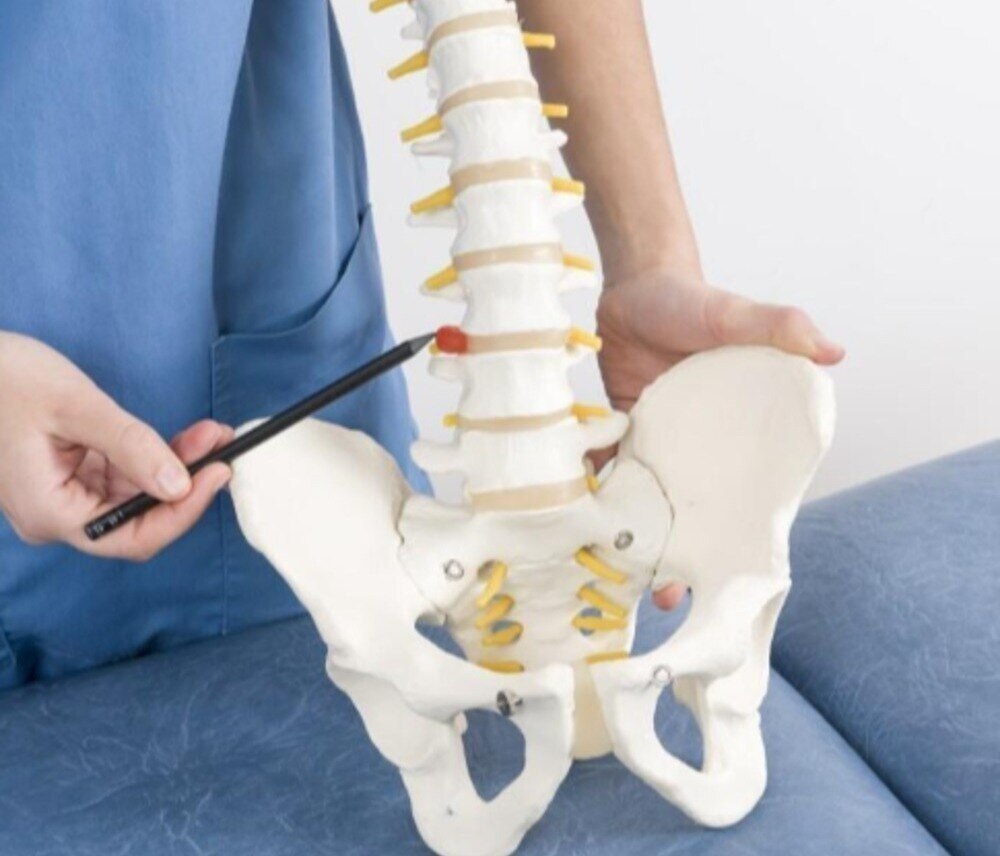
Radiating leg pain is the symptom pattern most suggestive of a lumbar disc pressing on a nerve. Pain following one leg in a recognisable path, combined with numbness, a reduced reflex, or weakness, points more strongly toward a treatable nerve-root problem than isolated low-back pain.
The MRI must match the examination: the same disc level and side should explain your symptoms. An incidental bulge does not justify surgery, and operating on a visible abnormality that does not match your pain can leave the real problem unchanged.
Weakness changes the decision because progressive loss of ankle, toe, or knee strength needs prompt assessment. Persistent disabling leg pain despite structured non-surgical treatment may support decompression, while numbness alone is judged by its severity, duration, and trend.
Back pain without meaningful leg symptoms is less reliably improved by disc surgery. Your clinician should investigate muscular, facet-joint, sacroiliac, hip, and other spinal causes before linking it to a disc.
Walking difficulty needs clarification. Pain that forces you to stop differs from weakness that makes the foot slap, or leg heaviness caused by narrowing around several nerves; each pattern leads to a different plan.
Seek emergency assessment for:
- New urinary retention or incontinence
- Loss of bowel control
- Numbness around the saddle area
- Rapidly worsening weakness
These signs can indicate severe nerve compression or cauda equina syndrome. Use this symptom-to-scan framework when comparing lumbar disc treatment choices in Pune.
When are medicines, physiotherapy, or an injection the better first step?
For uncomplicated sciatica from a confirmed lumbar disc herniation, non-surgical care is reasonable when strength is stable, cauda equina symptoms are absent, and pain remains manageable. Stay active within your limits, use clinician-selected analgesia, and follow an exercise-based physiotherapy programme; prolonged bed rest can delay recovery.
- Set a review point with your clinician after a structured trial of treatment, rather than waiting indefinitely.
- Continue if leg pain, numbness, walking tolerance, or function is improving.
- Reassess the plan if disabling sciatica persists, weakness develops, or daily activities remain severely restricted.
An epidural steroid injection can be discussed for acute, severe radiating leg pain when pain prevents sleep, walking, or participation in physiotherapy. It aims to reduce nerve inflammation for short-term relief; it does not remove the disc fragment or reliably prevent later surgery.
Do not use medicines, physiotherapy, or an injection to postpone urgent assessment for progressive weakness, loss of bladder or bowel control, saddle numbness, or rapidly worsening walking difficulty. Those symptoms require prompt evaluation for nerve compression.
When comparing lumbar disc treatment choices in Pune, ask whether the proposed step targets your dominant problem: nerve-root leg pain responds more predictably than isolated low-back pain. An injection is a symptom-control option, not a substitute for decompression when neurological loss is progressing.
When does decompression surgery fit, and which technique is used?
Decompression fits when leg pain follows a nerve pattern and remains disabling despite structured non-surgical care, or when weakness is progressing. MRI must show a disc fragment compressing the same nerve suggested by your symptoms and examination; an incidental bulge is not a reason to operate.
Severe or worsening weakness, loss of bladder or bowel control, or numbness around the saddle area requires urgent assessment.
| Option | What the surgeon does | When it fits |
|---|---|---|
| Microdiscectomy | Removes the protruding fragment through a small exposure, with only the bone or ligament needed to reach the nerve | A single-level soft-disc herniation causing concordant sciatica, numbness, or weakness |
| Endoscopic discectomy | Uses a narrow working channel and camera to remove the fragment | A suitable disc location and migration pattern, with anatomy and surgeon experience allowing a limited approach |
| Wider decompression or laminectomy | Removes more bone or thickened ligament to free one or more nerves | Spinal stenosis, facet overgrowth, ligament thickening, or compression at multiple levels |
Microdiscectomy and endoscopic discectomy are different routes to the same goal: nerve release, not guarantees of faster recovery. A wider decompression is not automatically better for a simple prolapse, while decompression alone may fail if the segment is unstable or significantly deformed.
When comparing lumbar disc surgery options in Pune, ask why the proposed route matches your MRI, weakness, pain distribution, and functional loss. The phrase best neurosurgeon lumbar disc surgery for options in pune is less useful than checking whether the clinician explains alternatives, risks, and what would change the plan.
Why is fusion not the default operation for an isolated disc prolapse?
A single prolapsed disc usually creates a nerve-pressure problem, not an unstable-spine problem. Decompression removes the offending disc fragment and any small amount of bone or ligament needed to free the nerve; it does not routinely remove the entire disc or join two vertebrae.
| Option | What it does | When it fits |
|---|---|---|
| Decompression or microdiscectomy | Removes the fragment pressing on the nerve | One-level herniation with matching leg pain, numbness, weakness, or reflex loss |
| Fusion | Uses implants and bone graft to stop movement between vertebrae | Demonstrable instability, significant spondylolisthesis, deformity, or selected recurrent herniation |
| No fusion | Preserves spinal movement and avoids implants | An isolated first-time prolapse without instability or a structural source of mechanical back pain |
Fusion is therefore not a stronger version of discectomy. It adds implants, longer recovery demands, and possible stress on neighbouring spinal segments, so using it without a stabilisation problem exposes you to extra treatment without addressing the main cause of nerve pain.
Ask whether the MRI level and side match your examination and dominant symptom. An incidental disc bulge will not explain pain simply because it appears on a scan.
During a consultation, compare lumbar disc surgery options in Pune by asking why decompression is enough, what finding would justify fusion, and how the plan changes if your symptoms are mainly back pain rather than radiating leg pain.
Searching for the best neurosurgeon lumbar disc surgery choices in pune is less useful than checking this reasoning, the neurological examination, alternatives, and consent discussion.
What should you ask during a lumbar disc surgery consultation in Pune?
A useful lumbar disc surgeon consultation in Pune should connect four points: your dominant symptom, neurological examination, MRI level and side, and the goal you want from treatment. An abnormal disc that does not match your pain or weakness is not a sound reason for surgery.
Whether you consult Dr Dilip Kiyawat or another specialist, compare the reasoning, not the title; neurosurgeons and orthopaedic spine surgeons can both perform appropriate decompression.
Ask:
- Which finding explains my leg pain, numbness, weakness, walking limitation, or back pain?
- Does the MRI abnormality match the same side and nerve level as my examination?
- What happens if I continue medicines, physiotherapy, or an epidural injection?
- Why does microdiscectomy, endoscopic discectomy, wider decompression, or fusion fit my case?
- What would change the plan, and what are the risks of dural tear, infection, nerve injury, recurrence, or persistent pain?
| Option | Evidence the surgeon should show | Warning sign |
|---|---|---|
| Decompression | A matching nerve deficit and MRI compression | Surgery aimed only at an incidental bulge |
| Fusion | Instability or another structural reason beyond an isolated prolapse | Fusion presented as automatic |
| Non-surgical care | A safe plan with review dates and escalation criteria | No explanation of what failure means |
Searching for “best neurosurgeon lumbar disc surgery choices in Pune” is less useful than comparing these answers. Seek urgent assessment, not a routine appointment, for new urinary retention, incontinence, bowel-control loss, saddle numbness, or rapidly worsening weakness.
Related product
 | Spine Surgery Prolapsed Lumbar Intervertebral Disc- Medical management The prolapsed lumbar intervertebral disc also referred to as slipped disc, sciatica, or just... View product → |
Frequently asked questions
How do symptoms suggest a lumbar disc is pressing on a nerve?
Pain travelling down one leg in a recognisable path, numbness, a reduced reflex, or weakness points more strongly to nerve-root compression than isolated low-back pain.
When are medicines, physiotherapy, or an injection better first steps?
These options fit when symptoms are manageable, neurological function is stable, and there is no emergency sign requiring prompt surgery. Your examination and MRI findings guide the choice.
When does decompression surgery fit for a lumbar disc problem?
Decompression fits when a disc compresses a nerve and leg pain, weakness, or numbness persists despite appropriate non-surgical treatment, or when neurological deficits worsen.
Why is fusion not the default operation for an isolated disc prolapse?
Fusion stabilises a spinal segment, while an isolated disc prolapse usually requires removal of the material pressing on the nerve. Fusion adds implants and recovery demands without addressing a stability problem that is not present.
What should you ask during a lumbar disc surgery consultation in Pune?
Ask which nerve is affected, whether your symptoms match the MRI, what non-surgical options remain, which decompression technique is proposed, whether fusion is necessary, and what recovery restrictions apply.